Teaching philosophy and ethics
We teach philosophy and ethics to audiences who have not always chosen it in their studies. Whether we are addressing future engineers or future social workers, the aim is less to pass on a doctrine than to make philosophy a way of thinking in practice, what the Greeks called praxis, and to help everyone build knowledge from their own field.
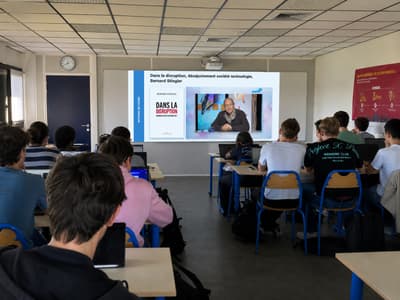
At ESILV, the Léonard de Vinci engineering school, we teach engineering ethics. These courses introduce the ethical, social and environmental issues of contemporary technologies. They open discussions on the engineer's responsibility and on the transformations of work, from the click workers who train artificial intelligence to the limits of techno-solutionism. We also talk about the place of gender in design and engineering. Students work on concrete cases taken from their future professions, to think about the role they will play in society.
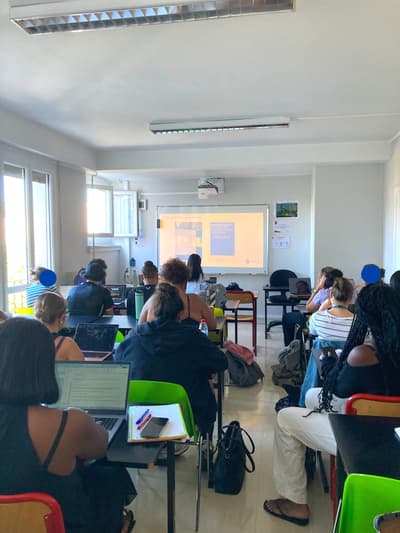
At IRTS, the regional institute for social work, we teach future social workers. The course draws on Bernard Stiegler's thought and his pharmacology of care to question the notions of autonomy and heteronomy, and to present the concept of pharmakon, which in Greek means both remedy and poison. Students bring ethical dilemmas they have met during their training, and the discussion helps them step aside and look at them differently.
From one audience to the other, we approach these subjects in different ways, but the intention remains to take the time to think where the urgency of the field rarely allows it.